


Map How Your Plant Is Actually Built
One shared model of your operation that people, applications, and AI can query, automate, and keep building on.
.png)
.png)
.png)
What Is Atlas?
Atlas gives manufacturers a shared understanding of how their operations actually work. It captures the relationships, knowledge, and context spread across your OT systems into a single operational model that can be queried, automated, and continuously delivered to people, applications, and AI.
Existing Systems Store.
Atlas Maps.
Atlas is a new layer that sits above your existing systems and layers meaning on the data they already hold...what the values are, how the equipment relates, and why it matters.
.png)
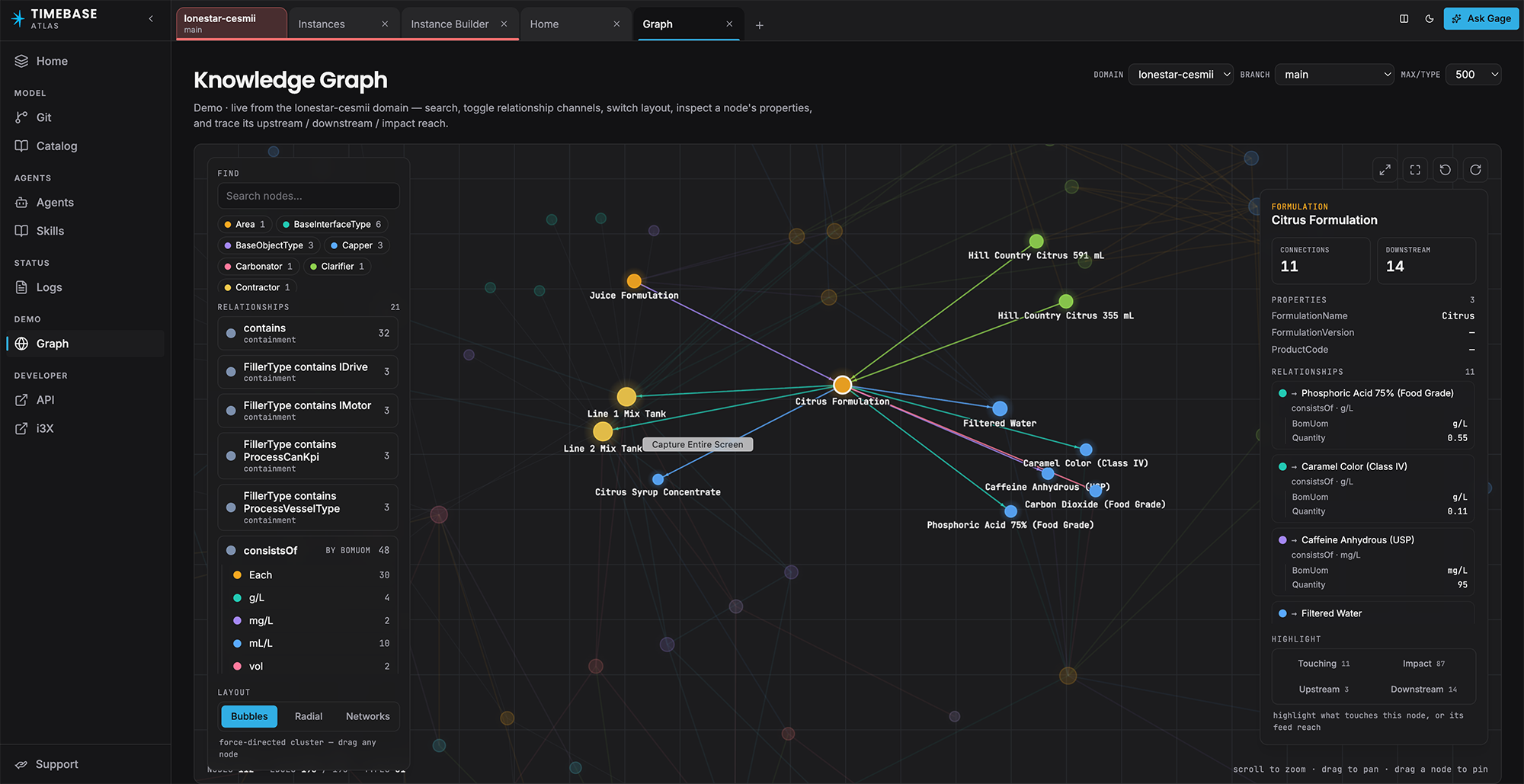
The Anatomy of a Knowledge Model
A Living Knowledge Model
Owning the knowledge graph means no per-node licensing drag, no external cluster to stand up before the first model exists, and an install footprint light enough to run at the edge of a single line or across an enterprise.
relationships are first-class citizens
- that the feed only occurs during fermentation
- the flow path it runs through
- the conditions under which it is valid
- the date it was commissioned
The flexibility is deliberate. You define the relationship types your operation actually uses, with the properties that matter to you, rather than bending your world to fit a fixed set of hierarchy rules. Two plants can model the same equipment differently because they run differently, and both models are valid.
libraries & governance
You choose the standards you want to use... ISA-95 for the enterprise, plant, area, and work-center hierarchy, ISA-88 for batch, recipe, procedure, and phase, ISA-5.1 for parsing instrument tags such as FIC-101 or PSH-202 into structured attributes, ISA-18.2 for alarm management, ISO 15926 for oil and gas asset lifecycle, and CESMII Smart Manufacturing Profiles. You import the standard, and it becomes live ontology in your model.
You also create your own, and this is the bigger idea. A control-module library of valves, motors, and PID loops, a corporate equipment standard, a recipe framework specific to your products. When an organization authors its own libraries, it takes governance over its model: the vocabulary is defined once, owned centrally, and every domain that consumes the library models under it.
Standards give you a proven starting point; your own libraries are how your organization governs what things mean. Once built, a library is reusable across every model that needs it, which is how a standard actually propagates across sites instead of being re-typed at each one.
Domains and how they federate
It is where a team actually does its modeling, and it consumes libraries to do so: a process-engineering domain might pull in ISA-88 and a recipe library, a maintenance domain pulls in an equipment-standard library and ISA-18.2, and each team models its own slice of the operation using the vocabulary those libraries provide. They do not need to understand the full enterprise model to contribute correctly to their piece of it.

See Your Operation Through Atlas
Gage, the AI Harness
.png)
Gage is the AI Harness. You simply connect your LLMs and models of choice to Timebase, and then can immediately use a series of agents and subagents to build, manage, instantiate, and query.
All required tools and skills are already in place, but you also have the ability to build your own tools and subagents so you can create what you need.
Since all Timebase components are API/MCP first, that means Gage is also not confined to just Atlas. It becomes your agent orchestration layer across all Timebase components, which means the same agent that builds and reasons on the Knowledge Model reaches the historian and the rest of the stack. One agent, one governed model, working across the entire platform rather than a chat box per product.
.png)
Gage partners with the domain expert. The agent knows how to model; the engineer knows what to model. It asks questions, proposes structure, and externalizes the tacit knowledge that has never had a home in any system. It does not generate a model on its own and ask for a rubber stamp. Domain experts stay the source of truth, and the agent is leverage on their expertise rather than a replacement for it. This is the difference between a tool that helps a knowledgeable engineer move faster and one that produces plausible structure nobody trusts.
.png)
Once built, the model is available to any agent that can call REST, through the MCP server and the .NET Agent SDK, the same pattern the Timebase Historian MCP server already uses. Progressive context traversal means an agent pulls only the relevant subgraph rather than the whole model, which keeps context windows clean and responses fast and reliable. The model is large; the context window is not, and the harness is built around that fact.
.png)
Everything that crosses the boundary
.png)
Atlas connects to every shape and source of data a real plant produces. The point of connecting a source is not to copy it: Atlas relates across sources and knows where the authoritative record lives without becoming the owner of it.
.png)
Bridge is the outbound mirror of Connector. It publishes data out of Atlas to downstream sinks: BI tools, external systems, other brokers, and custom consumers.